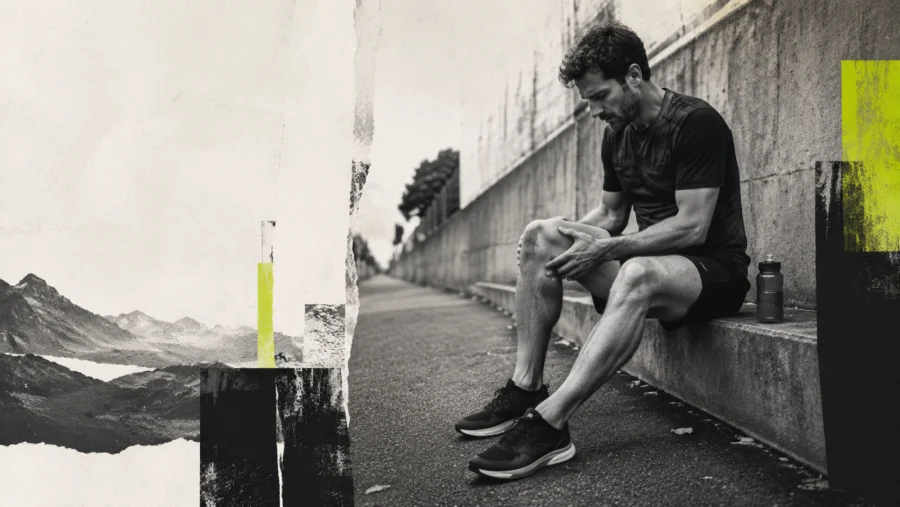
Pain around the kneecap can make every step feel like a warning. But runner’s knee does not automatically mean serious damage – or the end of your running. Here is how to recognise the usual pattern, adjust your training and rebuild the capacity to run comfortably again.
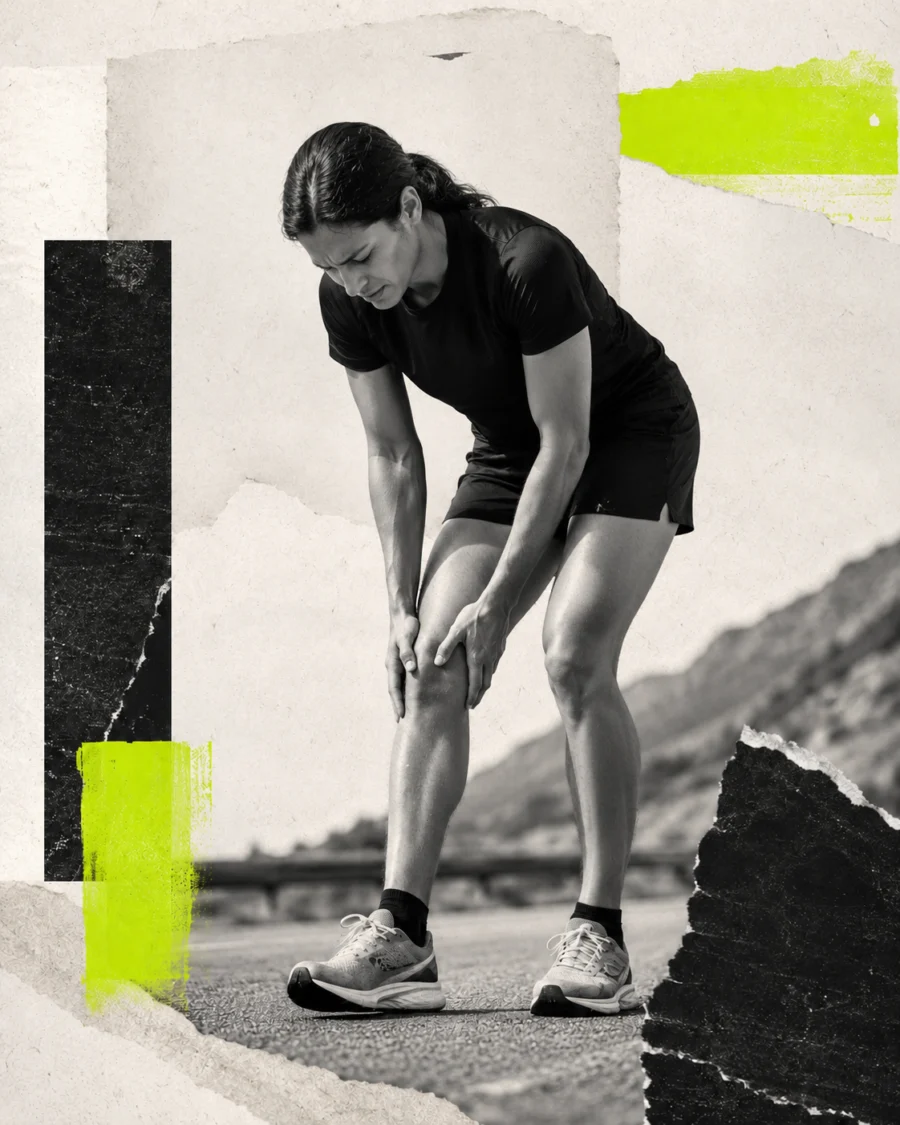
You finish a run with a dull ache at the front of your knee. Stairs feel uncomfortable later that day. The next morning, the first few squats are stiff and sore.
It is tempting to assume that running has damaged your knee – or that complete rest is the only answer. In many cases, neither is true.
“Runner’s knee” commonly refers to patellofemoral pain: pain around or behind the kneecap that is aggravated when the knee works under load. It is common, frustrating and sometimes persistent, but it is usually managed without surgery. The most effective approach is rarely a single stretch, pair of shoes or glute exercise. It normally involves understanding the trigger, temporarily adjusting the load and progressively strengthening the knee and surrounding muscles.
THE QUICK ANSWER
Runner’s knee is usually pain around or behind the kneecap that becomes noticeable during running, squatting, stairs, hills or prolonged sitting. It often develops when the demands of training rise faster than the knee’s current capacity to tolerate them.
The core recovery strategy is to:
- Make sure the symptoms fit patellofemoral pain and check for warning signs.
- Reduce the most aggravating part of training without necessarily stopping all activity.
- Build hip, thigh and calf strength progressively.
- Return to running in stages, guided by symptoms during the session and the following day.
Current best-practice guidance places education and exercise therapy at the centre of treatment, with options such as taping, foot orthoses or gait retraining used selectively rather than as universal cures.
WHAT IS RUNNER’S KNEE?
Runner’s knee is a popular term, not a precise medical diagnosis. Most often, it describes patellofemoral pain: discomfort arising from the area where the kneecap meets the thigh bone.
The usual clinical pattern is:
- Diffuse pain around or behind the kneecap
- Pain during running, squatting, lunging or jumping
- Discomfort on stairs, often more noticeable when descending
- Pain after sitting with the knee bent for a long time
- Symptoms that increase when training demand increases
According to the Journal of Orthopaedic & Sports Physical Therapy clinical practice guideline, patellofemoral pain is typically reproduced by activities that load a bent knee, such as squatting, stairs and running.
That does not mean every runner with knee pain has runner’s knee. Pain on the outside of the joint, a very specific tender point below the kneecap, sudden swelling after a twist, true locking or an inability to bear weight can indicate a different problem.
Where the pain is felt can offer a clue
| Symptom pattern | What it may suggest | What to do |
|---|---|---|
| Diffuse ache around or behind the kneecap, aggravated by running, squats or stairs | Patellofemoral pain | Reduce the aggravating load and begin progressive rehabilitation |
| Focal pain at the tendon just below the kneecap | Patellar tendinopathy | Seek a more specific assessment and loading plan |
| Pain on the outside of the knee, especially after a predictable time or distance | Iliotibial band-related pain | Review training load and obtain an assessment if persistent |
| Rapid swelling, a pop, instability or locking after a twist or fall | Possible ligament, meniscus or other joint injury | Stop running and seek clinical assessment |
| Hot, red, badly swollen knee or pain with fever | Possible infection or inflammatory problem | Seek urgent medical advice |
This table is not a diagnostic tool. Knee pain has several possible causes, and a clinician should assess symptoms that are severe, unusual or not improving.
WHY DOES RUNNER’S KNEE HAPPEN?
There is rarely one guilty muscle or one “bad” running technique. Patellofemoral pain is better understood as a mismatch between demand and capacity, influenced by several factors.
1. Your training load increased too quickly
A sharp rise in distance, frequency or total time on your feet can expose the knee to more stress than it is currently prepared to handle. The increase does not need to look dramatic on a training app. Adding an extra run while also walking more, playing another sport or working long shifts can raise the total load.
The answer is not a universal mileage rule. It is to progress from what you have recently tolerated, change one major variable at a time and watch how your knee responds over the next 24 hours.
2. You added hills, speed or downhills
Not all kilometres demand the same thing from the body. Faster running, hill repetitions and sustained downhill sections can increase the challenge at the front of the knee. A route change can therefore trigger symptoms even when weekly distance stays the same.
3. Your current strength does not match your running demands
The quadriceps help manage forces at the knee, while the glutes, hamstrings and calves contribute to control and propulsion. If these tissues are not prepared for the amount or intensity of running you are doing, the patellofemoral joint may become sensitive.
This does not mean weak glutes are always the root cause. Strength differences can be a contributor, a consequence of pain or simply one part of the picture. Research supports training both the hip and knee rather than searching for one defective muscle.
4. Recovery has fallen behind
Poor sleep, under-fuelling, illness, stress and too little space between demanding sessions can reduce how well you adapt to training. The route that felt manageable last month may feel very different during a stressful or poorly fuelled week.
Recovery does not make the knee magically stronger, but it helps you absorb the work that is intended to make it stronger.
5. You returned before rebuilding capacity
Rest may reduce pain because it removes the irritant. But if you resume the same mileage, hills and speed without rebuilding strength and running tolerance, symptoms can return quickly.
Pain relief is not always the same as full readiness.
6. You changed shoes or surfaces at the same time as training
Shoes and surfaces can alter how load is distributed, but they are rarely the sole explanation. Problems are more likely when a footwear change arrives alongside extra mileage, faster sessions or a new route.
Choose shoes that feel comfortable, introduce unfamiliar models gradually and avoid changing several variables at once. There is no single shoe type that prevents or cures runner’s knee for everyone.
7. Your individual movement pattern increases local demand
Running mechanics can matter, but visible differences are not automatically faults. Some runners may benefit from a targeted change – such as a small increase in step rate – while others will not.
A useful question is not, “Do I run perfectly?” It is, “Would changing this specific feature reduce symptoms without creating a new problem?” That decision is best based on an assessment rather than a generic social-media checklist.
CAN YOU RUN WITH RUNNER’S KNEE?
Sometimes – but the answer depends on the symptom pattern and response.
Running may remain part of rehabilitation when discomfort is mild and stable, does not make you limp or change your form, settles soon after the session and is back near its usual level by the next morning. Some runners will need a temporary reduction in duration, pace, frequency or hills; others may need a short break from running while they maintain fitness through a better-tolerated activity.
Use the knee’s response as information:
| Response | What it means | Next step |
|---|---|---|
| Green: no pain or mild, stable discomfort; normal gait; back near baseline the next morning | Current dose is probably tolerable | Repeat it before making a small progression |
| Amber: pain builds through the run, stairs are worse later, or symptoms remain elevated the next day | The dose was probably too high | Reduce duration, pace, hills or frequency |
| Red: sharp pain, limping, swelling, locking, giving way or inability to bear weight | This does not fit a simple “push through it” approach | Stop running and seek assessment |
This is a guide, not a validated universal pain rule. If you are unsure whether the symptoms are safe to load, consult a sports physiotherapist or another qualified healthcare professional.
WHAT TO DO DURING THE FIRST PHASE
For many runners, the goal is not complete rest. It is to reduce irritation while preserving as much useful activity as possible.
Remove the clearest aggravator
Temporarily reduce the part of training most strongly linked to symptoms. That may be long runs, downhills, speed sessions or running on consecutive days. An easy, flat run may remain comfortable even when a hard hilly route does not.
Keep moving within tolerance
Walking, easy cycling, swimming or an elliptical trainer may help maintain routine and aerobic fitness if they do not aggravate the knee. Cross-training is optional; it should not become extra workload that delays recovery.
Start strength work at a manageable level
Choose exercises you can perform with controlled technique and an acceptable symptom response. The starting variation may be shallow, supported or lightly loaded. That is not a permanent ceiling – it is simply where progressive loading begins.
Track the response, not every sensation
Record what you did, how the knee felt during it and how it responded the next morning. This is more useful than repeatedly testing the most painful movement throughout the day.
Ice or taping may offer short-term comfort for some people, but neither rebuilds capacity. If you are considering pain-relieving medication, ask a pharmacist or clinician what is appropriate for you; do not use it simply to mask worsening pain and complete a run.
THE BEST EXERCISES FOR RUNNER’S KNEE
There is no single best runner’s knee exercise. Evidence favours a programme that progressively trains both the hip and knee, adapted to the runner’s symptoms and goals. A multicentre trial found that both hip/core-focused and knee-focused programmes improved outcomes, with earlier pain reduction in the hip/core group; that does not make one approach universally superior.
Choose four or five exercises that cover the main functions below:
| Exercise | Main focus | Easier starting option | How to progress |
|---|---|---|---|
| Squat or leg press | Quadriceps and whole-leg strength | Supported box squat or reduced depth | Add range, then load |
| Split squat or step-up | Single-leg control and strength | Hold a rail or use a low step | Increase step height, range or load |
| Knee extension | Direct quadriceps capacity | Light band or tolerable range | Add resistance gradually |
| Hip abduction or lateral step | Lateral hip strength | Side-lying leg raise | Stronger band, cable or added load |
| Calf raise | Calf and ankle contribution | Double-leg raise | Single-leg, more range or load |
| Wall sit or isometric knee hold | A tolerable early loading option | Short hold at a comfortable angle | Longer hold or more load |
A practical starting point is two or three sessions per week, using two to four sets per exercise. Select a resistance that feels challenging while allowing controlled repetitions and a stable symptom response. The exact number of repetitions matters less than gradual progression and consistency.
Stage one: build tolerance
Begin with variations that do not cause sharp or escalating pain. Your early programme might include a supported squat, low step-up, banded hip exercise and double-leg calf raise.
Stage two: build running-specific capacity
Progress towards heavier squats or leg presses, split squats, single-leg step-downs, loaded calf raises and controlled hopping when appropriate. Later-stage exercises should prepare you for the forces, speed and single-leg demands of running – not just make you good at lying-down activation drills.
The 2016 international patellofemoral pain consensus statement and the 2024 best-practice guide both support exercise therapy, with combined hip- and knee-focused work forming a central part of management.
DOES GAIT RETRAINING HELP RUNNER’S KNEE?
It can help selected runners, but it is not compulsory.
A clinician might assess step rate, overstriding, trunk position, impact pattern and how symptoms change with a cue. One possible intervention is a modest increase in cadence – often tested within roughly five to ten per cent of the runner’s usual rate – to see whether it reduces symptoms. This is a trial, not a permanent prescription.
Do not force a new foot strike or copy another runner’s form simply because your knee hurts. A sudden technique change shifts load elsewhere and can irritate the calf, Achilles tendon, foot or ankle. Research in runners with patellofemoral pain suggests that education and load management matter, while gait retraining should be targeted to the individual rather than applied to everyone.
DO TAPING, ORTHOSES, BRACES OR FOAM ROLLING WORK?
These tools can have a role, but they are usually supporting actors.
| Option | Potential role | Limitation |
|---|---|---|
| Patellar taping | May reduce pain during exercise or daily activity in the short term | Effect varies and does not replace progressive loading |
| Prefabricated foot orthoses | May help some runners, particularly when there is a clear immediate response | Not everyone benefits; custom devices are not automatically better |
| Knee sleeve or brace | May provide warmth, confidence or temporary comfort | Does not correct a universal alignment problem |
| Foam rolling or massage | May temporarily ease tightness or discomfort | Does not build strength or running tolerance |
| Stretching | Useful when a genuine mobility restriction affects the plan | More flexibility is not automatically the answer |
| New running shoes | Comfort or a gradual change in load distribution | No shoe reliably cures runner’s knee |
The strongest plan is usually the one that uses short-term symptom relief to help you complete the longer-term work: sensible load management and progressive exercise.
A GRADUAL RETURN-TO-RUN PLAN
Before progressing, you should be able to walk briskly and complete your current strength exercises without a clear deterioration later that day or the next morning. These are practical checkpoints, not formal medical clearance criteria.
Stage 1: flat walk–run sessions
Start with short running intervals separated by walking on a flat, predictable route. Keep the pace easy and leave a recovery day between sessions.
Stage 2: continuous easy running
Gradually extend the running portions until you can complete an easy continuous run with a stable during-and-after response.
Stage 3: rebuild frequency or duration
Increase one main variable at a time. You may extend a run or add another running day, but doing both at once makes it harder to identify the knee’s current limit.
Stage 4: reintroduce hills
Add small doses of hills after flat running is well tolerated. Downhill volume may need particular care because it can be provocative for some runners.
Stage 5: bring back speed
Strides, tempo running and intervals come later. Introduce one type of faster work at a time and keep the overall dose modest at first.
There is no magic weekly percentage that suits every runner. Repeat a successful load before progressing it, and step back if the next-day response worsens.
HOW LONG DOES RUNNER’S KNEE TAKE TO RECOVER?
There is no reliable countdown. Some runners improve within several weeks after adjusting an obvious training error; others need several months to rebuild capacity and confidence. Symptoms that have been present for longer often take longer to settle.
It is also unhelpful to dismiss patellofemoral pain as something that always disappears on its own. Long-term studies show that a meaningful proportion of people continue to report symptoms, particularly when the problem has already been present for months. Earlier, active management is sensible – not because the knee is fragile, but because persistent pain can become harder to change.
Progress may first appear as less pain on stairs, a better next-morning response or the ability to tolerate more strength work. A pain-free personal best is rarely the first milestone.
COMMON RUNNER’S KNEE MISTAKES
Resting until the pain disappears, then returning at full volume
Rest can reduce symptoms without preparing the knee for the load that caused them.
Treating glute activation as the entire rehabilitation plan
Hip work can be useful, but the quadriceps, calf and knee itself also need progressive load.
Stretching and foam rolling without getting stronger
Temporary relief is welcome, but it is not the same as increased capacity.
Changing shoes, cadence, foot strike and training plan at once
Multiple simultaneous changes can overload another area and make it impossible to know what helped.
Using painkillers to complete a planned run
Masking an escalating symptom does not make the load appropriate.
Assuming every noise means damage
Painless clicking can be normal. Painful locking, rapid swelling, instability or an inability to bear weight is different and needs assessment.
WHEN TO SEE A PHYSIOTHERAPIST OR DOCTOR
Arrange a non-urgent assessment if the pain is worsening, keeps returning, affects normal daily activity, has not started improving after a few weeks of sensible self-management or leaves you unsure how to progress. A sports physiotherapist can help confirm the likely diagnosis, identify the most relevant contributors and build a graded plan.
Seek urgent medical advice if:
- The knee is badly swollen, deformed, hot or red
- You cannot move it or put weight through it
- It locks, repeatedly gives way or painfully clicks
- You heard a pop or crack during an injury and swelling appeared rapidly
- You have a high temperature or feel unwell alongside a hot, red knee
- You have severe or rapidly worsening pain
The NHS knee pain guidance provides current urgent-care advice for these symptoms. Follow the emergency guidance for your own country if you are outside the UK.
Typical patellofemoral pain is usually assessed through your history and a physical examination. A scan is not automatically required. Imaging may be considered when the presentation is atypical, there has been significant trauma, the knee has mechanical symptoms, or progress is not following the expected course.
THE RUNNER’S JOURNAL BOTTOM LINE
Runner’s knee is not a verdict on your body or proof that running has worn out your joints. It is usually a sign that the current demand and your knee’s present capacity are out of balance.
The most useful response is calm and active: identify what changed, reduce the aggravating dose, strengthen the hip and knee, then rebuild running one variable at a time. Taping, orthoses, shoes and gait cues may help selected runners, but none replaces progressive training.
Do not chase a perfectly pain-free day before doing anything. Chase a pattern of better tolerance: more comfortable stairs, stronger exercises, a stable next morning and gradually more running without a flare-up.
That is recovery you can measure.
RUNNER’S KNEE: FREQUENTLY ASKED QUESTIONS
Is runner’s knee a serious injury?
Patellofemoral pain is usually managed without surgery and does not automatically indicate structural damage. However, “runner’s knee” is an imprecise label. Severe pain, rapid swelling, locking, instability, trauma or an inability to bear weight needs assessment for other conditions.
Can I run through runner’s knee?
Some runners can continue with a reduced, modified dose when discomfort is mild and stable, gait remains normal and symptoms return near baseline by the next morning. Do not run through sharp or escalating pain, limping, swelling, locking or giving way.
What is the best exercise for runner’s knee?
There is no universal best exercise. Programmes that progressively train both the hip and knee have the strongest overall support. Squats or leg presses, split squats or step-ups, knee extensions, hip exercises and calf raises can all be useful when matched to your current tolerance.
Will a knee brace fix runner’s knee?
A sleeve, brace or tape may improve short-term comfort for some people, but it is unlikely to resolve the underlying load-capacity problem on its own. Use it as an adjunct to an active rehabilitation plan.
Will new running shoes cure knee pain?
No shoe reliably cures runner’s knee. Comfortable footwear can be part of the solution, particularly if symptoms followed an abrupt shoe change, but training load and physical capacity usually deserve equal or greater attention.
Should I ice runner’s knee?
Ice may temporarily reduce discomfort for some runners, but it is optional and does not speed every recovery. Protect the skin and do not use ice if you have impaired sensation or circulation. The main work remains load adjustment and progressive exercise.
How long should I stop running?
There is no standard period. Some runners only need to reduce hills, speed or duration; others need a short pause from running while they build tolerance. Your symptom response and diagnosis should guide the decision, not a fixed number of days.
Do I need an MRI for runner’s knee?
Not usually when the history and examination clearly fit patellofemoral pain. A clinician may consider imaging when symptoms are atypical, follow significant trauma, include swelling or mechanical locking, or fail to improve as expected.
RELATED READING
- How to Balance Running and Strength Training
- Heavy Legs but Not Sore? What Your Body Is Telling You
- How to Increase Running Mileage Safely
REFERENCES
- Willy RW, Hoglund LT, Barton CJ, et al. Patellofemoral Pain: Clinical Practice Guidelines. Journal of Orthopaedic & Sports Physical Therapy. 2019.
- Neal BS, Lack SD, Bartholomew C, et al. Best practice guide for patellofemoral pain. British Journal of Sports Medicine. 2024.
- Crossley KM, van Middelkoop M, Callaghan MJ, et al. 2016 Patellofemoral Pain Consensus Statement: recommended physical interventions. British Journal of Sports Medicine. 2016.
- Ferber R, Bolgla L, Earl-Boehm JE, Emery C, Hamstra-Wright K. Strengthening of the hip and core versus the knee for patellofemoral pain. Journal of Athletic Training. 2015.
- Esculier JF, Bouyer LJ, Dubois B, et al. Is combining gait retraining or exercise with education better than education alone in runners with patellofemoral pain?. British Journal of Sports Medicine. 2018.
- Collins NJ, Bierma-Zeinstra SMA, Crossley KM, et al. Prognostic factors for patellofemoral pain. British Journal of Sports Medicine. 2013.
- NHS. Knee pain: symptoms, self-care and urgent advice. Accessed 1 September 2026.
MEDICAL DISCLAIMER
This article is for general education and is not a diagnosis or a substitute for individual medical advice. Knee pain can have several causes. Seek urgent care for severe pain, inability to bear weight, major swelling or deformity, a hot red joint with fever, true locking, or significant trauma. If symptoms persist, worsen or repeatedly return, consult a qualified healthcare professional.