The route you enjoy at lunchtime can feel very different at seven in the evening. A dark stretch, a closed park gate or a pavement covered in wet leaves can change the whole run. You do not need to become fearless to keep running through winter. You need a route, a session and a way home that work in the conditions you actually have.
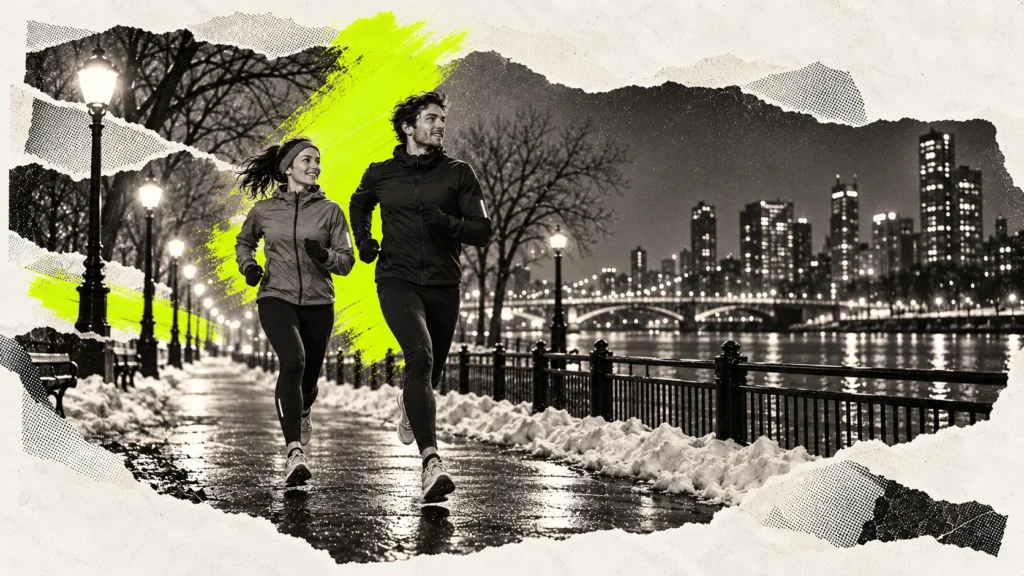
Make the route work after dark.
Start by checking the whole journey, including the walk home. A map can tell you where a path goes; it cannot tell you whether its lights work, whether the gate closes at dusk or whether you feel comfortable there. Explore an unfamiliar route in daylight before relying on it for an evening run.
A useful route audit has four parts: the surface, the crossings, the lighting and the places where you could finish early. Look for uneven paving, steps, slippery leaves and driveways as well as the obvious dark sections. Check access times for parks and tracks. A route that is technically open may still be a poor choice for the session you want to do.
For example, a familiar loop close to home can be easier to manage than an out-and-back that leaves you several kilometres from your front door. You can finish after one loop if conditions deteriorate. The trade-off is repetition; that is often worth accepting when the purpose is simply an easy run.
Write down a main route and one alternative. Make the alternative genuinely easier to use: a shorter lit loop, a group session, an indoor run or a different day. It should not require more planning than the original outing.
Seeing the ground and being seen.
A head torch and reflective clothing do different jobs. A torch helps you inspect the route ahead. Reflective material returns light towards its source when illuminated. Wearing something bright does not remove the need to check that you can see the surface and that other people can notice you.
Try your light on the kind of route you intend to use. Can you distinguish a kerb, a shallow puddle and a change in surface without having to slow suddenly? Does the beam bounce as you run? Does the strap stay comfortable over a hat or headband? Check these things before making the light part of a longer outing.
Choose a usable beam and battery life for your route rather than buying by a single brightness number. Check the manufacturer’s stated runtime at the setting you will actually use. Charge the light, check it works and consider a backup for outings where losing the main beam would make getting home difficult. Avoid directing a strong beam into another person’s eyes.
England Athletics links to night-running guidance for individuals and run leaders. Its advice is a useful starting point alongside a route-specific assessment; no item of kit can guarantee personal safety. [1]
Find a group you will want to return to.
Company can make an evening run more enjoyable and remove some of the practical uncertainty. The useful question is not just whether a club is nearby. It is whether its session fits your pace, experience, transport and available time.
Before a first visit, ask where the group meets, whether booking is needed, what the session involves and what happens if someone needs to slow down. Ask about pace ranges and regrouping rather than assuming that “all abilities” means the same thing everywhere. Find out whether the session ends where it starts and whether you need a light or high-visibility kit.
A simple message is enough: “I usually run for about 30 minutes at an easy effort. Is this session suitable, and who should I look for when I arrive?” Arriving a little early gives you time to introduce yourself without feeling rushed. You do not need a faster 5K time before making that enquiry.
Our running-club finder can help you build a shortlist. Confirm the current session details with the group itself. England Athletics’ Let’s Lift the Curfew work also highlights the barriers women face after dark and the role of clubs and communities in changing them. Responsibility for harassment belongs to the person causing it, not to the runner’s route or clothing choices. [2]
Match the session to what you can see.
Keep the purpose of the run, but be flexible about how you achieve it. An easy outing does not have to use your summer route or your usual pace. If you are repeatedly checking the ground, stopping at crossings or worrying about a dark section, the watch pace is not a useful comparison with an uninterrupted daytime run.
For a relaxed evening run, start gently on a familiar section and let the effort settle. Make room for a short warm-up and a gradual finish within the time you have. If you need to cross a road or inspect a surface, slow down or stop; do not protect a continuous running streak at the expense of a sensible decision.
A faster session needs a setting where the route, surface and other users suit it. A managed track session or a treadmill may be a more workable option than repetitions along a pavement with driveways and blind turns. Check track access and session rules first. If you use the treadmill instead, our treadmill watch guide explains why the recorded distance may differ.
If changing the session affects the rest of your week, move or simplify another run rather than squeezing two demanding sessions together. The running plan builder gives you a place to organise your available days; your judgement about current conditions still comes first.
Read more than the temperature.
The headline temperature is only part of the picture. Check wind, rain, weather warnings and what the surface is likely to be doing when you leave. The Met Office explains that moving air increases heat loss and affects the temperature you feel. Its “feels like” figure adds context; it is not a personalised clothing prescription. [3]
Look at your route specifically. An exposed stretch can feel different from a sheltered street. Standing water can hide uneven ground. Wet leaves, ice or poor visibility can make an otherwise familiar route unsuitable. If you cannot confidently assess the surface, changing the outing is a reasonable outcome of planning.
Have a way to deal with the time after running too. Waiting for a lift in damp clothing is different from arriving straight home. Keep a dry layer accessible if the run finishes away from home. Our guide to what to wear at 5°C and 10°C gives outfit examples and explains how wind, rain and effort change the choice.
Cold exposure is a health issue as well as a comfort issue. If you suspect hypothermia, including concerning signs such as confusion or slurred speech in someone who is very cold, the NHS says it needs emergency medical help. Do not try to solve that by running harder. [4]
A two-minute check before you leave.
- Route: know where you are going, the access times and where you could shorten it.
- Surface and weather: check the forecast and any warning that affects the actual outing.
- Light: test the beam and charge; check that you can see the ground.
- Clothing: think about visibility, wind and rain, plus the journey after the run.
- Contact: take a charged phone and, when useful, tell someone your route and expected return.
- Way home: have keys, payment or transport arrangements that do not depend on completing the full route.
If you share live location, agree who will look at it and what you want them to do if you are late. A location-sharing setting is not the same thing as someone actively watching the run. Think about whether publicly posting the start of a regular route reveals more than you intend.
Check how you will access essentials with cold hands or gloves. A phone buried beneath several layers may be difficult to use when you stop. Keep emergency contact and any personally necessary medical information accessible in a way that suits you.
An example you can adapt tonight.
Suppose you normally run for 40 minutes after work, but the middle of your usual route is unlit. You have a familiar, lit loop near home that takes roughly 12 minutes at an easy effort. Tonight’s plan could be a gentle start followed by two or three loops, with permission to finish earlier if the conditions or your comfort change.
The important details are the alternatives. If a light is broken or the surface feels slippery, use the shorter loop, go indoors or move the run. If you meet a friend, agree the route and pace before setting off rather than making the slower runner negotiate while already struggling. If you finish away from home, know where the warm layer is.
This is an example of a decision process, not a recommendation that everyone run for that duration. Use a distance and effort you already tolerate. The useful result is a completed, manageable outing, not proving that you can ignore discomfort or uncertainty.
What if the evening run still feels wrong?
You can choose a different time, a shorter route, a group or an indoor session without treating it as a failure of motivation. If evening running is repeatedly unpleasant, make that part of the weekly plan: perhaps a lunchtime run on one day and a weekend daylight outing on another.
After a few runs, keep a brief note of what helped. Was it the route, company, a better light or simply leaving earlier? Change one practical problem at a time. If you felt uncomfortable because of another person’s behaviour, do not turn that into a list of things you should have worn or done differently.
For a first week, choose one familiar outing and one fallback, prepare your kit and ask a group about a suitable session if company would help. You can build from that. General running guidance cannot assess a particular route, personal safety situation or health condition for you.


