The temperature says 8°C, but that still leaves plenty of decisions: shorts or leggings, one layer or two, gloves or no gloves? The best starting point is the weather, the effort and how long you will be out, followed by what you already know about your own comfort. Use the examples below to make a first choice, then adjust it from experience.
Start with the whole forecast.
Look beyond the temperature symbol. Check the wind, likely rain, any weather warning and whether your route is sheltered or exposed. The Met Office explains that wind changes heat loss from the body and affects the temperature you feel. A calm 7°C morning is not the same clothing decision as 7°C with wind and rain. [1]
Then think about the session. A gentle 25-minute outing, a faster session with recovery periods and a long run followed by a walk to the car can require different choices at the same temperature. The time before and after running also counts. If you will be standing still outside, plan for that separately.
Ask what you can change during the run. A zip, removable gloves or a layer you can comfortably carry give you options. A heavy layer that is difficult to remove may leave you committed to a choice that felt pleasant at the front door but is less comfortable once you are moving.
Your starting point does not need to match another runner’s. People differ in how warm they feel, how hard they are working and what clothing they find comfortable. Use their outfit as an idea, not proof that you have chosen incorrectly.
What to wear at 10°C and 5°C.
These examples are options to test on a short, familiar route. They are not a temperature-to-clothing rule, and they do not guarantee warmth or suitability in every condition. Start with clothing you own and make one useful adjustment at a time.
| Conditions | An outfit to consider | The adjustment to think about |
|---|---|---|
| Around 10°C, dry and calm | A light short- or long-sleeve top, with shorts or leggings you already find comfortable | An easy run, a windy route or feeling the cold may change what you need. |
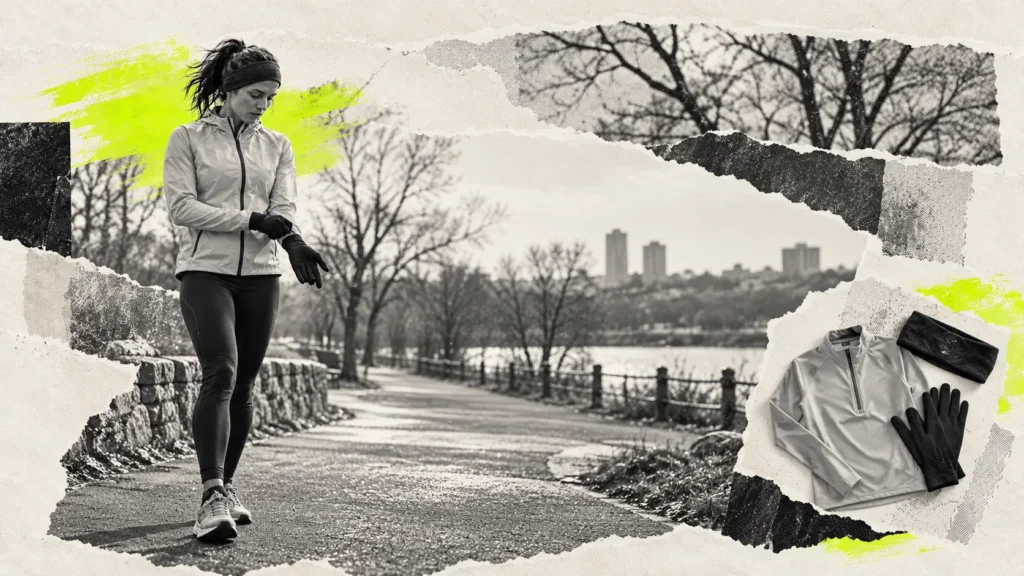
| Around 5°C, dry | A long-sleeve running layer; leggings if preferred; thin gloves or a headband | A removable light outer layer may suit a slower outing or someone who feels the cold. |
| Wind or rain at either temperature | An appropriate wind- or weather-resistant outer layer over familiar clothing | Check the actual conditions and whether the garment provides the protection you need. |
| Waiting before or walking after the run | An extra warmer layer, ideally kept dry until you need it | Plan for the period when you are no longer running, not just the moving part. |
For example, if you are warm in a long-sleeve top and leggings at 10°C, you may not also need a jacket on a calm run. If your hands stay uncomfortable even when your torso feels fine, thin gloves might solve the specific problem better than another thick upper-body layer.
At 5°C, a runner who prefers shorts may still want gloves and a long-sleeve top. Another may be much more comfortable in leggings and a light outer layer. The aim is a workable combination for you, not completing the run in the fewest items possible.
Understand what each layer does.
The next-to-skin layer is the top you will keep on through most of the run. Think about fit, seams and how it feels when damp. Technical synthetic fabrics and suitable merino clothing are common options, but the garment you already find comfortable may be a perfectly good starting point.
An insulating layer adds warmth when it is needed. More clothing is not automatically more useful for a run: a bulky layer can be awkward to carry once removed. A light option may be easier to adjust, especially on a route that moves between sheltered streets and exposed paths.
The outer layer is where you consider wind and rain protection. Read the garment’s description carefully. “Water-resistant” and “waterproof” are different claims; check intended use, construction and care instructions rather than assuming that every running jacket offers the same protection.
Breathability and ventilation matter for comfort as effort changes. Before buying another jacket, try the one you own on a short outing and note whether you become uncomfortable from outside weather, trapped warmth, rubbing or poor fit. Those are different problems with different solutions.
If clothing remains wet after the run and you will be outside, change into something dry when possible. The NHS identifies wet clothing and getting cold as factors in hypothermia. Clothing decisions should account for the whole outing. [2]
Solve the small discomforts.
Gloves and a headband can be small, easily carried adjustments. Check that you can operate a zip, reach a key and use the phone functions you need while wearing them. Thin gloves you can remove may be more useful on a mild run than a very warm pair that becomes uncomfortable quickly.
Think about socks and shoes in the conditions you expect. Check grip and the state of the route, not just whether a shoe is labelled for winter. Clothing cannot make an icy or flooded path a suitable running surface. If you are unsure of the ground, change the route or the session.
Notice seams, cuffs and points of contact with a running belt or jacket. A top that is comfortable for half an hour may behave differently when damp on a longer outing. Test new combinations near home before relying on them for a race or a long run.
Avoid solving every discomfort with another purchase. First identify the issue: cold fingers, a wet torso, rubbing under an arm or a jacket that rides up. Change the item associated with that problem and see whether it improves. You will learn more than by replacing the whole outfit at once.
Dress for the session and the waiting.
For an easy run, choose the effort and route first, then clothing you can adjust. If you need to walk at intervals, include that in the decision. Do not dress as if you will be running hard continuously when that is not the outing you have planned.
For a session with faster efforts, consider the warm-up, recovery periods and cool-down too. You may want a layer before the main work or while waiting for a group. Arrange somewhere practical to keep it; do not assume there will be a safe place to leave belongings at an unfamiliar venue.
For a race, the start area can be a bigger clothing problem than the running itself. Check the event’s bag-drop arrangements and rules for discarded clothing. Have a dry layer for afterwards and a plan for reaching it. Do not assume every event collects clothing for donation.
The race-day preparation planner can help you bring these decisions together with travel and your kit list. For an ordinary training run, a much shorter note is enough: what am I wearing while moving, what can I remove, and what will I put on afterwards?
Add rain and darkness to the decision.
If rain is forecast, consider both the moving part and the journey home. A short loop close to home leaves different options from an exposed route that finishes far from shelter. Check that the clothing you plan to use suits the actual weather, and keep a dry layer protected if you will need it afterwards.
At night, warmth and visibility are separate questions. A warm dark jacket does not necessarily help other people notice you. Reflective details and lights have different roles, and you still need to see the ground yourself. Our guide to running after dark covers a route check, lighting and finding suitable company.
Do not let a new jacket persuade you to ignore a warning or a surface you cannot assess. There are conditions in which moving the run is the useful choice. An indoor alternative can preserve some of the week’s structure without asking clothing to solve a problem it cannot solve.
If you become very cold and unwell, stop treating it as an outfit experiment. The NHS lists shivering, slurred speech and confusion among hypothermia symptoms and advises emergency help if hypothermia is suspected. Get to appropriate help rather than trying to run through it. [2]
Keep a clothing note that is worth using.
For a few runs, record four things: the conditions, the session, what you wore and what you would change. “8°C, dry but windy; 30 minutes easy; long-sleeve top and shorts; hands cold, torso fine” tells you much more than “winter kit did not work”.
Next time, thin gloves would be a focused change to test. You would not need to add a jacket and leggings as well to answer the original question. If the weather is very different, treat it as a new situation rather than expecting the previous outfit to work identically.
You may notice that you need more warmth for a slower outing, or a better outer layer for an exposed section. You may also find that your favourite combination is already in your drawer. The value of the note is making the next decision easier, not collecting data for its own sake.
On a first test of new clothing, use a familiar route with a way to shorten the run. That lets you learn about the outfit without making the outing depend on getting it right at the start.
Your next cold-weather run, simplified.
- Check air temperature, wind, rain and route conditions.
- Choose the session and include any walking or waiting.
- Start with a familiar outfit and one removable adjustment.
- Check gloves, phone access, fit and visibility where relevant.
- Have a dry layer for the period after running if you will need it.
- Choose a fallback when the weather or surface makes the route unsuitable.
You do not need a separate outfit for every degree on the forecast. A few familiar combinations, an understanding of what each layer does and a realistic way to adjust the outing will take you further than a rigid clothing chart.
There is no universal outfit that suits every runner at 5°C or 10°C. These are practical starting points for you to test, not individual medical or clothing-safety advice.