VO2 max for runners explained: learn what your score means, how accurate watch estimates are and how easy runs, intervals and recovery can improve it.
VO₂ max is often treated as the ultimate score for running fitness. Watches display it, training apps track it and runners compare it – but the number is only useful when you understand what it actually represents.
A higher VO₂ max gives you the potential to produce more energy aerobically, which matters in distance running. It does not, however, automatically make you a faster runner. Your running economy, lactate threshold, pacing, fuelling and ability to resist fatigue all help determine how well you turn that aerobic capacity into race performance.
Think of VO₂ max as the size of your aerobic engine. A bigger engine can be an advantage, but speed also depends on how efficiently you use it and how much of its capacity you can sustain.

What is VO₂ max?
VO₂ max is the maximum rate at which your body can take in, transport and use oxygen during intense exercise.
The name can be broken down simply:
- V means volume.
- O₂ means oxygen.
- Max means the maximum amount your body can use.
It is usually expressed as millilitres of oxygen used per kilogram of body mass per minute: ml/kg/min. A result of 50 ml/kg/min means that, at maximal effort, the body can use approximately 50 millilitres of oxygen per kilogram of body mass each minute.
Relative values make it easier to compare people of different sizes, although body mass, sex, age, genetics, training background and the testing method can all affect the result. For that reason, comparing your current result with your own previous results is often more useful than comparing it with somebody else’s.
What happens inside the body?
When you run, your working muscles need energy. During aerobic exercise, the body uses oxygen to help convert stored carbohydrate and fat into a usable form of energy called ATP. ATP powers muscle contraction.
Getting oxygen from the air to the working muscles involves several linked stages:
- You breathe oxygen into the lungs.
- Oxygen passes from the lungs into the blood.
- Haemoglobin in red blood cells carries it around the body.
- The heart pumps oxygen-rich blood to the working muscles.
- Muscle cells use the oxygen inside structures called mitochondria to produce energy.
VO₂ max reflects the highest rate at which this entire system can operate. In healthy runners, one of the main limits is often the cardiovascular system’s ability to deliver oxygen-rich blood, particularly the amount of blood the heart can pump each minute. Muscles also adapt by developing more capillaries, improved mitochondrial function and a greater ability to extract and use the oxygen delivered to them.
This is why VO₂ max is a measure of the whole oxygen-delivery and energy-production system, rather than simply a measure of lung size or how deeply you can breathe.
Why does VO₂ max matter for running?
The faster you run, the more energy your muscles require. A large proportion of that energy comes from the aerobic system in events lasting several minutes or longer. A higher VO₂ max raises the ceiling for aerobic energy production, potentially allowing a runner to support a faster pace.
It is therefore an important part of endurance performance. However, runners with similar VO₂ max values can produce very different race times. Three major factors help explain why:
1. VO₂ max: the size of the engine
This is your maximum aerobic capacity – the greatest amount of oxygen you can use during hard exercise.
2. Lactate threshold: how much of the engine you can sustain
As running intensity rises, lactate production and other changes associated with fatigue begin to increase more quickly. Your lactate threshold broadly describes the highest intensity at which the body can maintain a relatively stable response before fatigue begins to build much faster.
A runner who can sustain a larger percentage of their VO₂ max for a long time may outperform someone with a higher VO₂ max but a lower sustainable fraction.
3. Running economy: how efficiently you use the engine
Running economy is the amount of oxygen – and therefore energy – required to run at a given pace. A more economical runner uses less energy at the same speed.
Technique, tendon stiffness, muscle coordination, strength, footwear, terrain and training history can all influence economy. This helps explain why the runner with the biggest aerobic engine is not always the fastest.
For distance performance, the most useful question is not simply, “How high is my VO₂ max?” It is: How quickly and economically can I run while using a sustainable proportion of it?
How is VO₂ max measured?
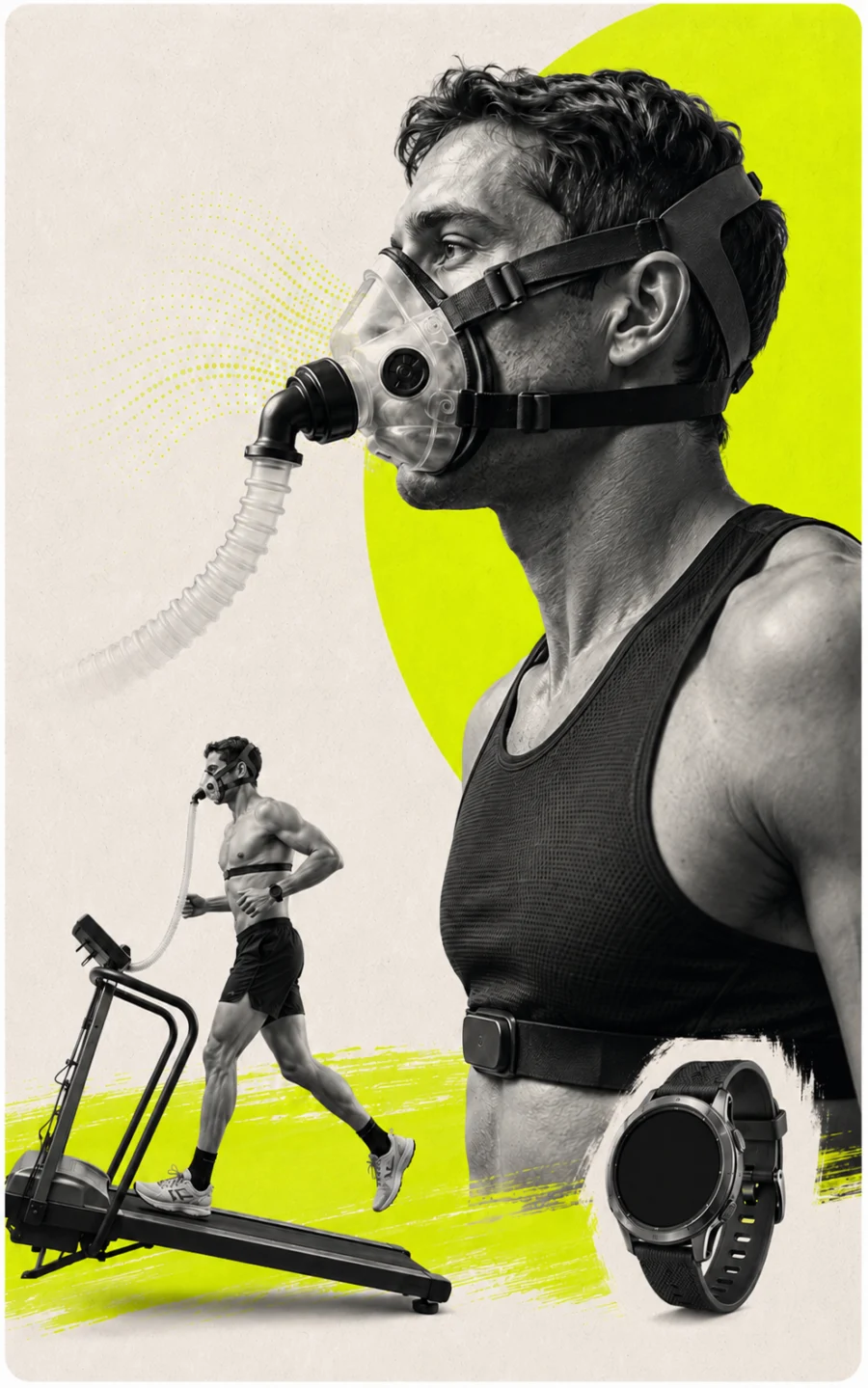
The most accurate method is a graded exercise test in a laboratory. You run on a treadmill while wearing a mask connected to equipment that measures the oxygen and carbon dioxide in your breath. The speed or incline gradually increases until you reach exhaustion.
The equipment calculates how much oxygen you are using at each stage. A true VO₂ max is traditionally associated with oxygen use levelling off even when the workload continues to rise, although this plateau does not appear clearly in every test. In practice, the highest value recorded may be reported as VO₂ peak.
Laboratory testing is useful when precision matters, but most recreational runners do not need it. Field tests, such as a hard 12-minute run, can estimate aerobic fitness from performance. These tests are influenced by pacing, motivation, weather, terrain and fatigue, so repeating the same protocol under similar conditions gives the most meaningful comparison.
How accurate is the VO₂ max on a running watch?
A watch does not directly measure the oxygen you breathe in and out. It estimates VO₂ max using information such as heart rate, running speed, age and body data, with the exact calculation depending on the manufacturer.
Research suggests exercise-based wearable estimates can be useful, but individual error remains. Heat, hills, wind, inaccurate wrist heart-rate readings, fatigue, dehydration, medication and incorrect maximum-heart-rate settings can all affect the result.
Treat the watch number as a trend, not a laboratory measurement. A change over several weeks under similar conditions is more informative than a one-point rise or fall after a single run. Race results, workout pace at a given effort and how well you recover should also be part of the picture.
How can runners improve VO₂ max?
Both steady endurance training and interval training can improve VO₂ max. The best programme combines enough easy running to build aerobic fitness with a controlled amount of harder work.
Build a consistent aerobic base
Easy and long runs increase the amount of aerobic work you can tolerate and support adaptations including greater blood volume, capillary growth and improved mitochondrial function. They also allow you to accumulate training without the recovery cost of running hard every day.
Most easy running should feel conversational. You should be able to speak in full sentences and finish feeling that you could continue. This work may not feel dramatic, but it provides the foundation that allows harder sessions to be effective.
Add one controlled interval session
Intervals allow you to spend repeated periods working close to your maximum aerobic capacity while short recoveries help you maintain the quality of each effort.
A practical session for an experienced runner is:
- 10-15 minutes of easy running, followed by a few short strides
- 4 × 3 minutes at a hard but controlled effort
- 2-3 minutes of easy jogging between repetitions
- 10 minutes of easy running to cool down
The effort should feel around 8-9 out of 10. Your breathing will be heavy and conversation will be limited to a few words, but the first repetition should not be a sprint. Aim to keep the pace consistent across all four efforts.
Newer runners could begin with 6 × 1 minute hard and 2 minutes easy, or use uphill efforts to reduce pace pressure. More experienced runners may progress to repetitions lasting three to five minutes. Progress the session gradually by adding a repetition or slightly extending the work periods – not by changing everything at once.
Include threshold training
Threshold sessions may not target VO₂ max as directly as hard aerobic intervals, but they improve the percentage of your aerobic capacity that you can sustain. An example is 3 × 8 minutes at a “comfortably hard” effort with 2 minutes of easy jogging between repetitions.
At threshold effort, you should be working with concentration but still feel in control. It is slower than a short interval pace and should not become an all-out time trial.
Use strength training to support running economy
Strength training is not a direct VO₂ max session, but it can support performance by improving force production, coordination and running economy. Exercises such as squats, split squats, deadlift variations and calf raises can help runners produce the required force with less relative effort.
Recover enough to adapt
Fitness improves after the training stimulus, when the body has time and resources to adapt. Hard sessions placed too close together can reduce their quality and increase fatigue or injury risk.
For many recreational runners, one VO₂ max-style session per week is enough, particularly when the programme also contains a long run, threshold work or strength training. Keep at least one easy or rest day after demanding sessions, eat enough carbohydrate to support quality training and prioritise sleep.
A balanced week for a four-run-per-week runner
One possible structure is:
- Run 1: Easy run
- Run 2: VO₂ max intervals
- Run 3: Easy or steady run
- Run 4: Long easy run
Threshold work can be alternated with the interval session across different weeks, or added cautiously once recovery and training experience allow. The exact structure should reflect your current mileage, injury history, race goal and experience.
How quickly can VO₂ max improve?
Some runners see measurable changes within several weeks, but the size and speed of improvement vary. People who are newer to structured endurance training often have more room to improve, while well-trained runners may make smaller gains.
Genetics influence both your starting point and how strongly you respond to training. Age, consistency, training intensity, total volume, recovery, illness, altitude and test accuracy also matter. A short-term plateau does not mean your running has stopped improving: your lactate threshold, economy and fatigue resistance may still be developing even if the displayed VO₂ max is unchanged.
Common mistakes to avoid
- Chasing the watch score: Train for better performance and health, not a daily algorithm update.
- Turning every interval into a sprint: VO₂ max sessions require hard, repeatable work. Starting too fast reduces useful time at the intended intensity.
- Adding too much intensity: More hard running is not automatically better. It can compromise consistency and recovery.
- Ignoring easy mileage: Lower-intensity running supports aerobic development and makes quality sessions sustainable.
- Comparing numbers without context: Different devices, test methods and individual characteristics can produce different values.
The takeaway
VO₂ max tells you how large your aerobic engine is, but it does not tell the whole story of your running.
A strong runner combines aerobic capacity with good running economy, a well-developed lactate threshold, sensible pacing and the ability to resist fatigue. Build your base with consistent easy running, add controlled quality sessions, recover properly and judge progress using more than one number.
Don’t just chase a higher VO₂ max. Build the fitness that helps you run better.
References and further reading
- Bassett, D. R. Jr. and Howley, E. T. (2000). Limiting factors for maximum oxygen uptake and determinants of endurance performance. Medicine & Science in Sports & Exercise, 32(1), 70-84. https://pubmed.ncbi.nlm.nih.gov/10647532/
- Joyner, M. J. and Coyle, E. F. (2008). Endurance exercise performance: the physiology of champions. The Journal of Physiology, 586(1), 35-44. https://pmc.ncbi.nlm.nih.gov/articles/PMC2375555/
- Barnes, K. R. and Kilding, A. E. (2015). Running economy: measurement, norms, and determining factors. Sports Medicine – Open, 1, 8. https://pmc.ncbi.nlm.nih.gov/articles/PMC4555089/
- Milanović, Z., Sporiš, G. and Weston, M. (2015). Effectiveness of high-intensity interval training and continuous endurance training for VO₂ max improvements in healthy adults. Sports Medicine, 45, 1469-1481. https://pubmed.ncbi.nlm.nih.gov/26243014/
- Molina-Garcia, P. et al. (2022). Validity of estimating the maximal oxygen consumption by consumer wearables: a systematic review with meta-analysis and expert statement. Sports Medicine, 52, 1577-1597. https://pubmed.ncbi.nlm.nih.gov/35072942/
This article is for general educational purposes and is not a substitute for individual medical advice. If you have a health condition, symptoms during exercise or are returning after illness or injury, seek advice from an appropriate healthcare professional before beginning high-intensity training.