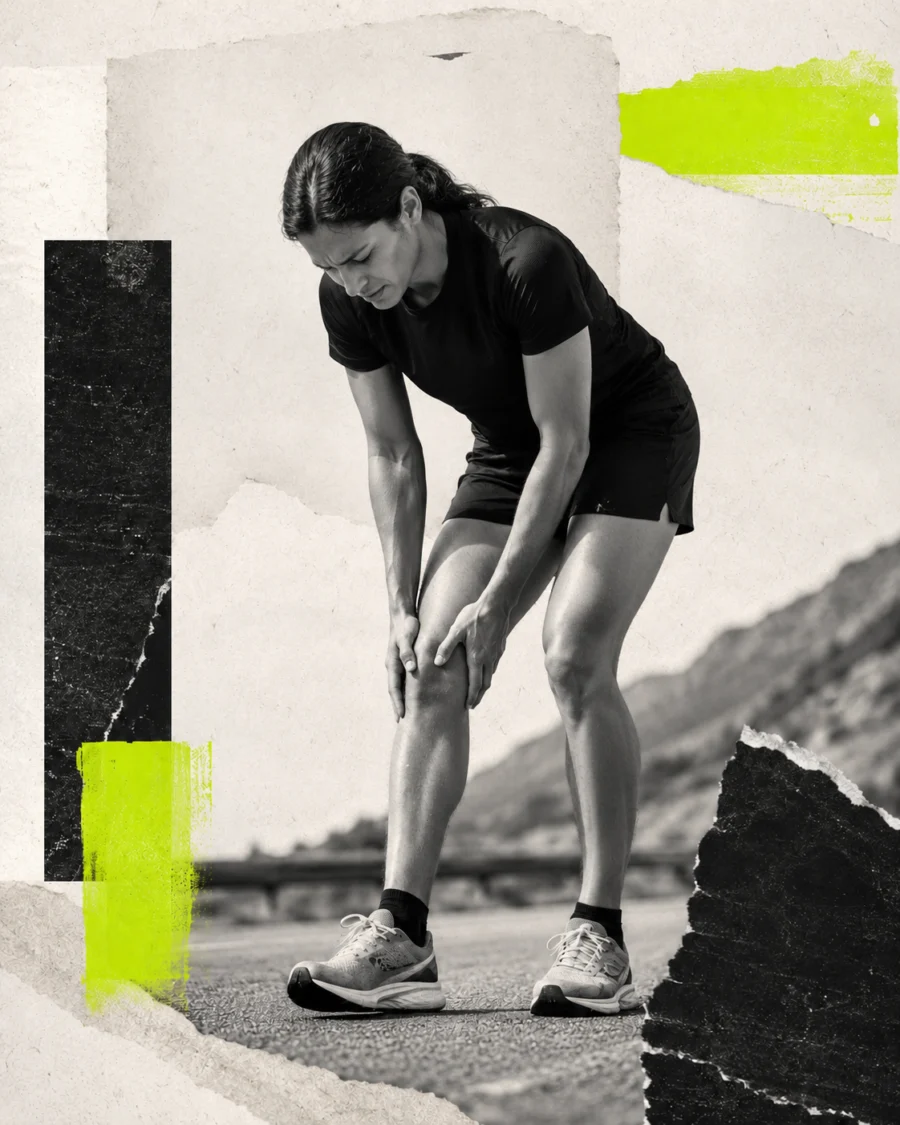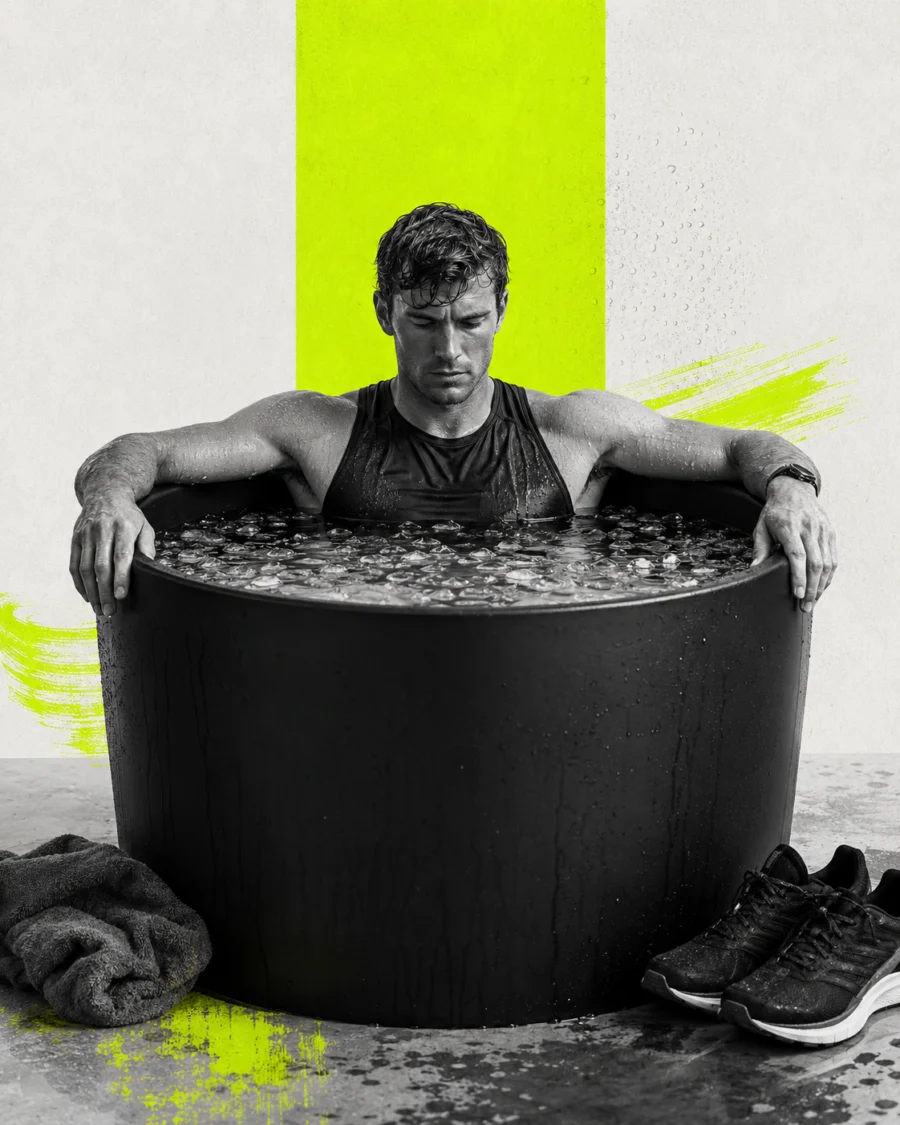
Ice baths may reduce soreness after running, but feeling fresher does not always mean your body has recovered faster. Here is what cold-water immersion actually does – and when runners should use it.
The modern recovery routine apparently requires a wearable score, a protein shake and the voluntary decision to sit in a container of painfully cold water.
Cold plunges have moved from professional training centres into gyms, gardens and social media feeds. Athletes praise them for reducing soreness, improving recovery and developing mental resilience – usually while trying very hard not to look cold.
But do ice baths actually help runners recover?
The evidence is more complicated than the before-and-after video.
Cold-water immersion can reduce muscle soreness and improve how recovered you feel after difficult exercise. It may also help restore certain aspects of performance, particularly when another demanding session is approaching.
That does not make it necessary after every run.
Regular cold-water immersion immediately after strength training may interfere with some of the adaptations runners are trying to develop. The benefits also depend on the exercise completed, the water temperature, the immersion time and what you need to do next.
Sometimes the cold plunge is useful.
Sometimes the best recovery strategy is simply eating, sleeping and leaving your body alone.
THE SHORT ANSWER
Ice baths can be useful for runners when short-term recovery matters more than long-term adaptation.
Research suggests cold-water immersion may:
- Reduce delayed-onset muscle soreness
- Improve perceived recovery
- Help restore some measures of strength and endurance
- Reduce thermal strain after running in hot conditions
- Be useful between closely scheduled races or training sessions
However, ice baths do not consistently:
- Repair muscle damage faster
- Improve every measure of performance
- Prevent injury
- Replace sleep or adequate nutrition
- Improve long-term running fitness
- Need to follow every run
They may also blunt strength and muscle adaptations when used repeatedly immediately after resistance training.
The question is not simply whether ice baths work.
It is whether they support the adaptation you currently want.
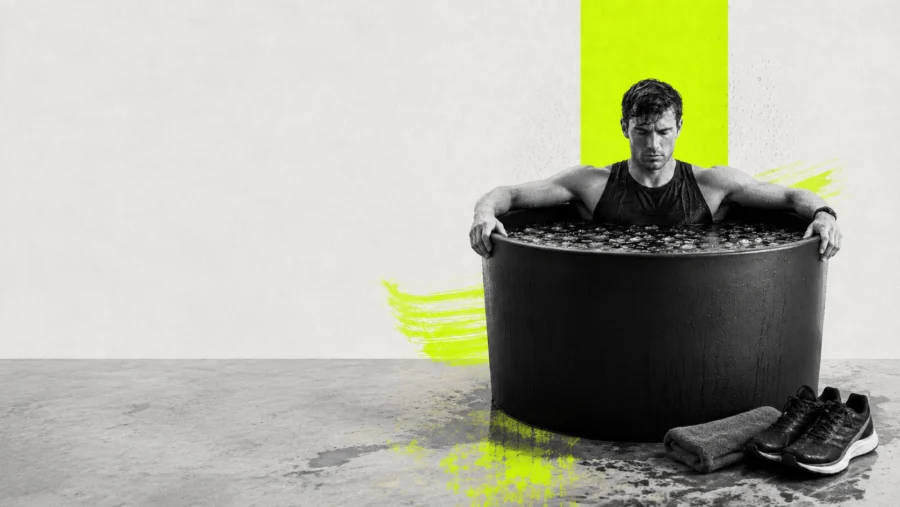
WHAT COUNTS AS AN ICE BATH?
Research usually refers to the practice as cold-water immersion.
This involves submerging part or most of the body in water below normal swimming-pool temperature for a set period after exercise.
Despite the name, the bath does not necessarily need to contain actual ice.
A 2026 systematic review classified cold-water immersion protocols as:
- Cold: 5–8°C
- Moderate: 9–12°C
- Mild: 13–20°C
The studies also varied considerably in duration, from less than ten minutes to more than fifteen.
For endurance recovery, moderate temperatures of approximately 9–12°C for 10–15 minutes appeared promising, but the researchers rated the evidence as low certainty.
There is no universally proven perfect protocol.
Making the water colder does not automatically make the recovery more effective. It mainly makes the experience more unpleasant.
WHAT HAPPENS TO YOUR BODY IN COLD WATER?
Cold water causes blood vessels near the skin and immersed muscles to narrow. This reduces blood flow to the area and lowers tissue temperature.
Cold exposure can also:
- Reduce nerve-conduction speed
- Temporarily alter pain perception
- Reduce swelling
- Change cardiovascular activity
- Increase alertness
- Reduce skin and muscle temperature
- Affect inflammatory signalling
These changes may explain why runners often feel less sore after an ice bath.
The reduced sensation of soreness is real. The mistake is assuming this always proves that the underlying tissue has repaired more quickly.
Pain, inflammation, muscle damage and performance recovery are related, but they are not identical.
You can feel better without every biological recovery process being complete.
DO ICE BATHS REDUCE MUSCLE SORENESS?
This is where the evidence is strongest.
Several systematic reviews have found that cold-water immersion can reduce delayed-onset muscle soreness after strenuous exercise.
A 2023 review comparing cold-water immersion with other common recovery methods found that it was more effective for reducing muscle soreness and produced similar results for the recovery of muscular power and flexibility.
A 2025 review also found that cold-water immersion reduced delayed-onset muscle soreness, although improvements in objective measures such as jumping performance and creatine kinase were less consistent.
The latest evidence therefore supports a fairly unexciting conclusion:
Cold water can help you feel less sore.
That may be valuable after a race, a very demanding long run or an unusually dense training period. It does not necessarily mean an ice bath is improving every part of recovery.
DO ICE BATHS HELP RUNNING PERFORMANCE RECOVER?
Possibly, depending on the situation.
A systematic review of 68 studies found that cold-water immersion improved short-term recovery of endurance performance approximately one hour after exercise. The benefit appeared stronger after exercise completed in warm conditions.
The same review found improvements in some longer-term measures of strength and power recovery, alongside reduced muscle soreness and better perceived recovery.
However, the results changed according to:
- The type of exercise
- The time between sessions
- Environmental temperature
- Water temperature
- Immersion duration
- The performance test used
Cold-water immersion temporarily impaired sprint and jump performance at certain early time points.
If you climb directly out of an ice bath and attempt explosive hill sprints, your legs may not interpret this as the sophisticated recovery protocol you intended.
Allow your body to warm before completing another demanding activity.
FEELING RECOVERED IS NOT THE SAME AS BEING RECOVERED
Recovery research often measures several outcomes:
- Muscle soreness
- Perceived fatigue
- Strength
- Power
- Endurance
- Blood markers associated with muscle damage
- Inflammatory markers
These do not always change together.
An ice bath may improve soreness without producing an equivalent improvement in strength. It may reduce a blood marker without changing performance. It may make an athlete feel more prepared without accelerating every repair process.
This does not make the benefit imaginary.
Perceived soreness matters, particularly when discomfort affects movement, confidence or willingness to train.
It simply means runners should avoid using one outcome as proof of complete recovery.
A quieter set of quadriceps is not necessarily a fully repaired set of quadriceps.
CAN ICE BATHS REDUCE TRAINING ADAPTATIONS?
This is the main reason not to use them automatically.
Training works because exercise temporarily disrupts the body. Your muscles, tendons, cardiovascular system and nervous system then adapt to become better prepared for similar stress in future.
Some of the inflammation and cellular signalling following exercise is part of that process.
Repeatedly applying cold water immediately after training may reduce certain signals involved in adaptation.
A study by Roberts and colleagues followed physically active men completing strength training for twelve weeks. Participants who completed active recovery developed greater increases in muscle mass and strength than those who used cold-water immersion after every session.
A later systematic review found that regular cold-water immersion had a negative effect on resistance-training adaptations, including maximal strength, strength endurance and explosive performance.
The evidence does not suggest that one ice bath will remove your strength gains.
The concern is regular use immediately after sessions designed to stimulate strength or muscle growth.
What this means for runners
If your gym work is intended to improve strength, power and tissue capacity, avoid making an ice bath the automatic final exercise.
Use cold-water immersion selectively rather than after every strength session.
This is especially relevant if you are trying to combine running and strength training without compromising either.
DOES COLD WATER INTERFERE WITH ENDURANCE ADAPTATION?
The concern appears smaller for endurance training.
Systematic reviews have generally found that regular cold-water immersion does not significantly reduce improvements in aerobic performance.
Some researchers have suggested that cooling could support endurance adaptation in certain situations, particularly when it allows an athlete to complete subsequent training more effectively.
However, there is not enough evidence to recommend cold-water immersion as a way to improve endurance fitness.
An ice bath may help you manage a demanding training period. It does not create the adaptations produced by the running itself.
WHEN MIGHT AN ICE BATH BE USEFUL?
Cold-water immersion makes the most sense when rapid recovery is the immediate goal.
After a race
An ice bath may help reduce soreness after a half marathon, marathon or trail race.
At that point, you are not trying to maximise the training stimulus from the event. You are usually trying to walk downstairs with some remaining dignity.
Between closely scheduled events
Cold-water immersion may be useful during:
- Multi-day competitions
- Running festivals
- Relay events
- Tournament-style sports
- Training camps
- Closely scheduled hard sessions
Reducing soreness and improving perceived recovery may help when another performance is required before normal recovery is complete.
After running in the heat
Cold-water immersion can reduce body temperature and may support short-term recovery after exercise in hot conditions.
Cooling should still be approached carefully. Someone showing signs of heat illness requires appropriate first aid and medical assessment—not an improvised social-media recovery experiment.
During a very demanding training block
Selective use may help runners tolerate a temporary period of high training load.
The word selective is doing considerable work here.
A planned overload block is different from being permanently exhausted because every week has accidentally become an overload week.
WHEN SHOULD YOU SKIP THE ICE BATH?
Cold-water immersion is probably unnecessary after:
- A normal easy run
- A short recovery run
- A routine gym session
- Every strength workout
- A session that did not create unusual soreness or heat strain
- Training followed by several days of recovery
You should also reconsider it when:
- Building strength or muscle is the priority
- You need to perform explosive exercise immediately afterwards
- The cold causes numbness, pain or dizziness
- You have a medical condition affected by cold exposure
- You are using it to compensate for insufficient sleep or food
- You simply hate it
A recovery method does not become essential because it is uncomfortable.
ARE ICE BATHS SAFE?
Cold-water exposure produces a genuine physiological stress response.
Entering very cold water can rapidly increase breathing rate, heart rate and blood pressure. The British Heart Foundation warns that cold shock may cause shortness of breath and can present additional risks for people with heart conditions.
Speak to an appropriate healthcare professional before using cold-water immersion if you have:
- A heart or circulatory condition
- High blood pressure
- Raynaud’s phenomenon
- Poor circulation
- Reduced skin sensation
- A condition affecting temperature regulation
- A history of fainting
- Concerns about pregnancy and cold exposure
- Any medical reason cold immersion may be unsuitable
Stop immediately if you experience chest pain, severe breathlessness, dizziness, confusion, numbness or uncontrollable shivering.
Do not combine cold-water immersion with deliberate hyperventilation or breath-holding.
An ice bath is not the place to discover how long you can ignore your body’s emergency signals.
HOW SHOULD RUNNERS USE AN ICE BATH?
There is no single evidence-based protocol suitable for everyone.
If cold-water immersion is appropriate for you:
- Use a clean, stable container that you can exit easily.
- Begin with cool rather than extreme water.
- Enter gradually and control your breathing.
- Immerse the legs rather than forcing full-body immersion.
- Keep your head and neck out of the water.
- Use a timer.
- Have warm, dry clothes ready.
- Warm up gradually afterwards.
- Avoid completing another explosive session while still cold.
- Never continue because a social-media timer says you should.
The 2026 network meta-analysis suggested that approximately 9–12°C for 10–15 minutes may support endurance recovery, but the certainty was low and the authors warned against universal protocols.
A shorter, less aggressive exposure may be more appropriate for someone new to cold-water immersion.
Partial immersion appears capable of providing similar soreness benefits to whole-body immersion. You do not need to sit up to your neck in a bin to prove you are serious about recovery.
SHOULD YOU TAKE AN ICE BATH AFTER A LONG RUN?
Not routinely.
After a standard long run, prioritise:
- Rehydration
- Carbohydrate
- Protein
- Dry clothing
- Gentle movement
- Sleep
- An appropriate easy day afterwards
Consider cold-water immersion when the long run was unusually demanding, completed in significant heat or followed by another important session within a short period.
If you are repeatedly so sore after long runs that you feel dependent on ice baths, review the training itself.
The issue may be pace, distance progression, strength capacity, footwear, recovery time or inadequate fuelling.
Cold water can reduce the complaint without resolving its cause.
WHAT ABOUT A COLD SHOWER?
A cold shower is less intense and easier to control than full immersion.
It may improve alertness and provide a subjective sense of recovery. However, most cold-water immersion research cannot be applied directly to showers because the temperature, pressure and amount of tissue exposed are different.
A cool shower is a reasonable option if it makes you feel better.
Just avoid presenting it as a medically precise recovery intervention because you turned the temperature dial to blue for 45 seconds.
ARE THERE BETTER RECOVERY METHODS?
That depends on what is limiting your recovery.
If the problem is energy depletion, you need food.
If the problem is dehydration, you need fluid and electrolytes.
If the problem is sleep deprivation, you need sleep.
If the problem is excessive training load, you need an easier programme.
If the problem is muscular soreness, cold-water immersion may help – but massage, compression and light movement may also reduce perceived soreness.
A large systematic review found massage particularly effective for reducing delayed-onset muscle soreness and perceived fatigue.
None of these methods can compensate indefinitely for inadequate recovery foundations.
Before buying a recovery tub, check whether you are displaying any signs of under-fuelling.
Your body may need a meal more urgently than it needs ten kilograms of supermarket ice.
A SIMPLE DECISION GUIDE
| Situation | Is an ice bath useful? |
|---|---|
| Normal easy run | Usually unnecessary |
| Standard weekly long run | Optional, but rarely needed |
| Marathon or very demanding race | May reduce soreness |
| Another competition within 24–48 hours | Potentially useful |
| Run completed in significant heat | May support cooling and short-term recovery |
| Immediately after strength training | Avoid routine use if strength adaptation matters |
| Before explosive training | Usually unhelpful |
| Illness, dizziness or medical concerns | Avoid and seek appropriate advice |
| Poor recovery caused by under-fuelling | Food is the priority |
| You dislike cold immersion | Choose another recovery method |
THE BOTTOM LINE
Ice baths are neither a recovery miracle nor a complete waste of time.
Cold-water immersion can reduce soreness and improve perceived recovery after demanding exercise. It may also support short-term performance recovery when runners need to compete or train again quickly.
The benefits are less convincing when ice baths are used after every ordinary run.
Repeated cold-water immersion immediately after strength training may reduce some of the adaptations runners want from lifting. Extreme temperatures also add unnecessary risk without guaranteeing better results.
Use cold water when rapid recovery has a clear purpose.
Skip it when adaptation matters more – or when the main reason you are doing it is that everyone else online appears to own a very expensive plastic barrel.
ICE BATHS FOR RUNNERS: FREQUENTLY ASKED QUESTIONS
Do ice baths actually help runners recover?
Ice baths can reduce muscle soreness and improve perceived recovery after strenuous exercise. Their effects on strength, endurance and biological markers of muscle damage are less consistent.
How long should a runner stay in an ice bath?
Research uses a wide range of protocols. Approximately 10–15 minutes at 9–12°C has been studied for endurance recovery, but the evidence is not strong enough to make this a universal recommendation. New users should consider milder and shorter exposure.
Should I take an ice bath after every long run?
No. Most routine long runs do not require an ice bath. Prioritise food, hydration, sleep and sensible training progression. Cold-water immersion may be more useful after an unusually demanding run, a race or exercise in significant heat.
Do ice baths reduce muscle growth?
Regular cold-water immersion immediately after resistance training may reduce muscle and strength adaptations. Occasional use after a race is unlikely to erase your gym progress.
Is a cold shower as effective as an ice bath?
There is less evidence for cold showers because they do not cool the body in the same way as immersion. They may still improve alertness and perceived recovery, but the findings from ice-bath research cannot be applied directly.
Should I use an ice bath after a marathon?
It may reduce soreness and help you feel more comfortable after a marathon. Make sure you have eaten, rehydrated and changed into dry clothing first. Avoid cold immersion if you feel unwell, dizzy or have a condition that makes cold exposure unsuitable.
Does colder water produce better recovery?
Not necessarily. Research does not show that extreme cold automatically produces better outcomes. Very cold water increases discomfort and the cold-shock response.
REFERENCES
- Yu T, Liu Y, Ding C, et al. Cold-water immersion protocol optimisation across resistance training, endurance exercise and team sports: a systematic review and network meta-analysis. BMC Sports Science, Medicine and Rehabilitation. 2026.
- Moore E, Fuller JT, Bellenger CR, et al. Effects of cold-water immersion compared with other recovery modalities following acute strenuous exercise. Sports Medicine. 2023.
- Choo HC, Lee M, Yeo V, Poon W, Ihsan M. The effect of cold-water immersion on the recovery of physical performance revisited: a systematic review with meta-analysis. Journal of Sports Sciences. 2022.
- Ma J, Guo C, Luo L, et al. Cold-water immersion alone and combined therapy for recovery of muscle fatigue after exercise. Life. 2025.
- Malta ES, Dutra YM, Broatch JR, Bishop DJ, Zagatto AM. The effects of regular cold-water immersion on training-induced changes in strength and endurance performance. Sports Medicine. 2021.
- Roberts LA, Raastad T, Markworth JF, et al. Post-exercise cold-water immersion attenuates acute anabolic signalling and long-term adaptations in muscle to strength training. The Journal of Physiology. 2015.
- Dupuy O, Douzi W, Theurot D, Bosquet L, Dugué B. An evidence-based approach for choosing post-exercise recovery techniques. Frontiers in Physiology. 2018.
- British Heart Foundation. Cold-water swimming: is it bad for your heart?.
DISCLAIMER
This article is for general educational purposes and does not replace medical advice. Cold-water immersion can affect breathing, heart rate, blood pressure and body temperature. Consult a qualified healthcare professional before using it if you have a cardiovascular or circulatory condition, reduced sensation, are pregnant or have another relevant medical concern. Stop immediately and seek help if you experience chest pain, severe breathlessness, dizziness, confusion or loss of consciousness.