Learn how to choose running shoes based on fit, comfort, cushioning and terrain – not marketing hype. An evidence-based guide for every runner.
Choosing running shoes should not require expertise in foam technology. Here are the seven things that genuinely matter – from fit and comfort to cushioning, support and the type of running you actually do.
Walk into a running shop and you will be presented with enough foam names, plate materials and midsole technologies to suggest you are buying a small aircraft rather than a pair of trainers.
Every shoe promises something.
More energy return. Softer landings. Greater stability. Effortless speed. Possibly a new personality.
But learning how to choose running shoes does not need to be complicated. The best shoe is not automatically the most expensive, the softest or the one currently appearing in every runner’s social media feed.
It is the shoe that fits your foot, feels comfortable and suits the running you actually do.
Here is what genuinely matters.
THE SHORT ANSWER
Choose a running shoe that:
- Fits securely without squeezing your toes
- Feels comfortable immediately
- Suits your usual terrain and training
- Provides the amount of support you prefer
- Does not force your foot into an unnatural position
- Allows you to run without rubbing, pressure or instability
You do not need to select a shoe based solely on your arch height, foot shape or the amount you pronate. Research has not identified one universally “correct” running shoe for every type of runner.
Comfort, fit and purpose are better places to start.
1. START WITH FIT – NOT THE COLOUR
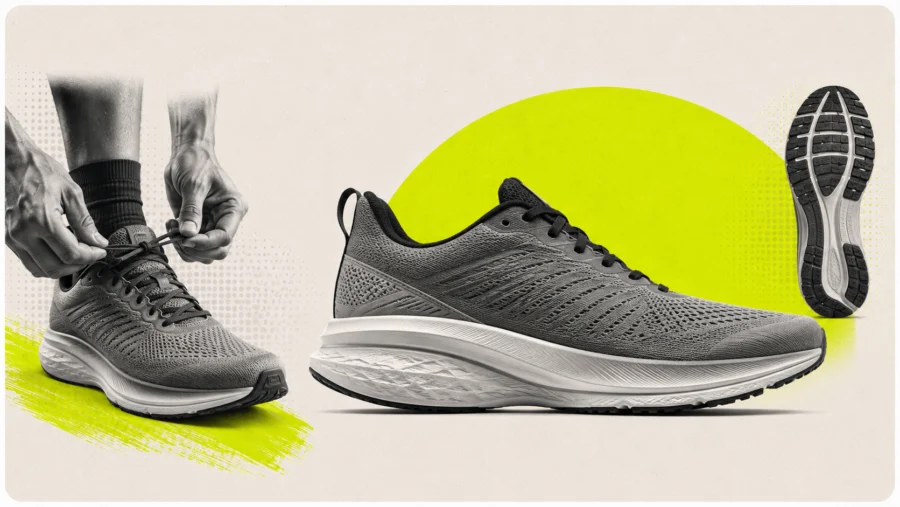
A running shoe can contain the latest foam technology and still be completely wrong for you if it does not fit properly.
Your feet move and swell while running, particularly during longer sessions. A shoe that feels perfectly snug while standing in a shop may become increasingly less charming at kilometre 18.
A good running-shoe fit should provide:
- Space for your toes to move naturally
- No pressure against the end or sides of the toe box
- A secure heel that does not repeatedly lift
- A comfortable hold around the midfoot
- No pinching, rubbing or obvious pressure points
- Enough volume across the top of the foot
Many runners aim for approximately a thumb’s width between their longest toe and the end of the shoe. Treat this as a useful starting point rather than an exact law. Foot shape, toe length and personal preference all matter.
Your running-shoe size may be half a size or more above your everyday shoe size. Do not become emotionally attached to the number printed on the box.
Different brands – and even different models from the same brand – can fit differently.
Do not ignore the width
Shoe width is just as important as length. If the upper is bulging around the sides of your foot or your toes are being pushed together, going up a full size may only create an unnecessarily long shoe.
You may need a wider fit instead.
Research into toe-box design suggests that the shape and available space around the toes can influence movement and deformation inside the shoe. A small 2024 randomised crossover study found that a raised toe box reduced pressure and deformation around the big toe in male marathon runners.
You should not need to “break in” a running shoe that is painful or restrictive. The midsole may soften slightly, but the basic shape is unlikely to transform itself out of respect for your feet.
2. COMFORT IS MORE IMPORTANT THAN SHOE MARKETING
There is no single measurement that can identify the perfect running shoe for every runner.
Researchers have proposed the idea of a comfort filter: runners may naturally prefer footwear that allows their body to move in a familiar and comfortable way. The theory is discussed in a widely cited review of running shoes and injuries.
Comfort is not proof that a shoe will prevent injury, but it remains a useful selection tool.
When trying a shoe, ask:
- Does the cushioning feel comfortable at my normal running pace?
- Does my stride feel natural?
- Do I feel stable when landing and turning?
- Is any part of the shoe distracting me?
- Would I want to continue running in it for another hour?
A shoe should feel good during movement—not just while you are standing on a padded shop floor.
If possible, jog on a treadmill or use a retailer that allows you to test the shoes properly. Try more than one model and compare them before checking which one costs the most.
Your feet have no interest in the recommended retail price.
3. DO NOT PANIC ABOUT PRONATION
Pronation is the natural inward movement of the foot as it absorbs load. Almost everyone pronates to some degree.
For years, runners were routinely placed into neutral, stability or motion-control shoes based on the appearance of their arches or the amount their ankles rolled inwards.
The evidence is considerably less straightforward.
A study following 927 novice runners found that moderate foot pronation was not associated with a greater injury risk when participants ran in neutral shoes.
A larger Cochrane review also found no evidence that selecting running shoes according to static foot posture reduced lower-limb injuries. However, much of the available footwear research was rated as low or very low certainty.
This does not mean stability shoes are pointless.
One randomised trial involving 372 recreational runners found a lower injury risk in runners given motion-control shoes, with the clearest benefit appearing among runners with pronated feet.
The practical answer is more nuanced than “pronation is bad” or “support never matters”.
A stability shoe may be worth trying if:
- You feel noticeably unstable in neutral shoes
- Your foot collapses heavily inwards and causes discomfort
- You have previously run comfortably in supportive footwear
- A physiotherapist or podiatrist has recommended additional support
- You simply prefer the sensation of a more guided shoe
Modern stability shoes often use broader platforms, raised sidewalls and shaped midsoles rather than a hard block under the arch. They can provide guidance without making the shoe feel like corrective equipment.
Choose support because it feels useful – not because somebody has told you that your feet are structurally incorrect.
4. UNDERSTAND CUSHIONING, STACK HEIGHT AND HEEL DROP
Running-shoe descriptions contain several measurements that sound more complicated than they are.
Cushioning
Cushioning refers to the material under your foot and how soft, firm or responsive it feels.
More cushioning does not automatically mean more protection. Some laboratory studies have found that highly cushioned shoes can increase impact loading because runners adjust their leg stiffness and landing mechanics.
For example, one biomechanical study found greater impact loading in a highly cushioned maximalist shoe compared with a conventional running shoe.
That does not mean heavily cushioned shoes are dangerous. Other studies have produced different findings, and laboratory impact measurements do not translate directly into injury risk.
The important point is that softer is not automatically safer.
Stack height
Stack height describes how much material sits between your foot and the ground.
A higher stack can provide:
- More cushioning
- A softer sensation
- Greater comfort over long distances
- Less feeling of the ground
However, a very tall shoe may feel less stable, particularly when turning, running on uneven surfaces or if the base of the shoe is narrow.
A lower-stack shoe normally provides more ground feel and flexibility but may feel firmer underfoot.
Neither is universally better.
Heel-to-toe drop
Heel drop is the difference in height between the heel and forefoot.
For example, if a shoe has 30mm of material under the heel and 22mm under the forefoot, it has an 8mm drop.
A higher drop can shift slightly more demand towards the knees, while a lower drop may place greater demand on the calves, Achilles tendons and feet. These are general tendencies, not guarantees.
A randomised trial involving 553 runners found that heel drop did not change overall injury risk. The researchers did find different results when runners were separated by experience, demonstrating how difficult it is to label one drop as the safest.
If you are comfortable in your current shoes, there is rarely a compelling reason to make a dramatic change.
Moving from a traditional 10mm-drop shoe to a zero-drop model should be treated as a gradual transition—not an exciting experiment for the morning of your longest run.
5. MATCH THE SHOE TO THE RUNNING YOU ACTUALLY DO
Before buying a shoe, decide what its job will be.
A runner completing three relaxed road runs each week has different requirements from someone preparing for a trail ultra or chasing a 5K personal best.
| Shoe type | Designed for | What to expect |
|---|---|---|
| Daily trainer | Easy runs and general mileage | Comfortable, durable and versatile |
| Stability shoe | Runners who prefer additional guidance | Broader or more supportive platform |
| Max-cushioned shoe | Long runs and comfort-focused mileage | High stack and generous cushioning |
| Lightweight tempo shoe | Intervals and faster training | Lighter, firmer or more responsive ride |
| Carbon-plated racing shoe | Races and race-specific sessions | Lightweight foam and a stiff, propulsive design |
| Trail shoe | Mud, gravel and uneven surfaces | Greater grip, protection and a trail-specific outsole |
If you are buying your first running shoe
Start with a versatile daily trainer. It should feel comfortable during easy running while remaining responsive enough for occasional faster efforts.
You do not need a carbon plate, a specialist recovery shoe and a separate trainer for Wednesdays.
If you mainly run on roads
Look for a road-running shoe with a smooth outsole, suitable cushioning and enough grip for wet pavements.
If you run on trails
The outsole becomes far more important. Consider the depth and spacing of the lugs, the technical difficulty of the terrain and whether you need additional protection around the toes.
A heavily lugged trail shoe may feel uncomfortable on long sections of road. A smooth road shoe can turn a muddy descent into an unscheduled confidence exercise.
If you are racing
A lighter or plated shoe may improve running economy, but it should still fit properly and feel stable. Test it during training before wearing it on race day.
Nothing new on race day includes footwear, however attractive the unopened box may be.
6. TREAT GAIT ANALYSIS AS INFORMATION – NOT A VERDICT
A running gait analysis normally involves filming you on a treadmill while you run. A member of staff may assess your foot strike, ankle movement, cadence and general running pattern before suggesting particular shoes.
This can be helpful when it allows you to:
- Compare different shoes while running
- See how stable you look and feel
- Identify obvious discomfort or movement differences
- Discuss previous injuries
- Narrow down an overwhelming selection
However, a short treadmill recording cannot predict every future injury or identify one medically perfect shoe.
A 2025 randomised crossover study found that the way shoes were described as “gait-matched” affected runners’ perceptions of comfort, performance and injury protection—even when the experimental shoes were otherwise identical.
Most participants still preferred their own familiar shoes.
This does not make gait analysis useless. It shows that runners can be influenced by presentation, terminology and the perceived authority of a recommendation.
Use gait analysis as one part of the decision. It should support your experience of the shoe, not overrule it.
Be cautious if you are told:
- One shoe will prevent all injuries
- Your pronation must be corrected
- Your foot strike is automatically wrong
- You need the most expensive model available
- Pain is normal while you adjust to the shoe
A shop assistant can help you compare footwear. Persistent pain, repeated injuries or significant movement concerns should be assessed by an appropriately qualified physiotherapist, podiatrist or sports medicine professional.
7. IGNORE THE PRICE TAG – THEN TEST THE SHOE
Expensive shoes may use lighter materials, more responsive foam or advanced plate technology. That can be useful for racing and faster training.
It does not make them automatically more comfortable, durable or appropriate for you.
A £220 racing shoe can be a poor choice for someone who needs a dependable daily trainer. Equally, a discounted previous-season model may perform almost identically to the updated version.
When comparing shoes, try not to look at the price or marketing category until you have assessed the fit and feel.
Use this quick test
Run briefly in each pair and consider:
- Fit: Are my toes comfortable and my heel secure?
- Comfort: Is there any rubbing or pressure?
- Stability: Do I feel controlled when landing and turning?
- Movement: Does the shoe work with my stride?
- Purpose: Is it suitable for most of my planned running?
- Value: Will I use it enough to justify the cost?
If two shoes feel equally good, choose the less expensive one.
You have just successfully outperformed the marketing department.
WHAT ABOUT RUNNING-SHOE ROTATION?
You do not need multiple pairs of running shoes, but a rotation can be useful once your training becomes more varied.
A simple rotation might include:
- A comfortable daily trainer for easy mileage
- A lighter or more responsive shoe for faster sessions
- A trail shoe if you regularly run off-road
Using different shoes may change how load is distributed through the lower body. One observational study found that runners using more than one pair of shoes had a lower injury risk than those relying on a single pair.
That does not prove shoe rotation prevents injury, but it can help you match your footwear to each session and avoid wearing one pair into the ground.
WHEN SHOULD YOU REPLACE RUNNING SHOES?
The frequently quoted lifespan is approximately 300–500 miles, or around 500–800 kilometres. This is a guideline rather than an expiry date.
Shoe lifespan depends on:
- The construction of the shoe
- Your running style
- Your body weight
- The surfaces you use
- How frequently you wear the shoes
- How the shoes are stored and cared for
Consider replacing a pair when:
- The outsole has worn through significantly
- The cushioning feels noticeably flat or uneven
- The shoe leans to one side when placed on a level surface
- The upper no longer holds your foot securely
- You experience repeated rubbing that was not there previously
- The shoes feel less comfortable than a newer pair
- Unexplained aches repeatedly appear when wearing them
Do not replace shoes solely because your running app has reached an arbitrary number. Equally, do not keep running in a collapsed pair because the upper still looks impressively clean.
THE RUNNER’S JOURNAL BUYING CHECKLIST
Before leaving the shop—or removing the labels at home—check that:
- Your toes are not touching the end
- The toe box is wide enough
- Your heel feels secure
- The upper does not pinch
- The arch is not being uncomfortably pushed
- The shoe feels stable at your normal pace
- You have tested both feet
- You are wearing your usual running socks
- The shoe suits your main running surface
- You know what role it will have in your training
Do not buy a shoe because you hope it will become comfortable.
Buy the shoe that already is.
THE BOTTOM LINE
The running-shoe industry would quite like you to believe that choosing trainers requires an understanding of proprietary foams, carbon geometry and energy-return percentages.
It does not.
The most important factors are fit, comfort and purpose.
Start with enough room around the toes, a secure hold through the heel and midfoot, and a level of cushioning that feels natural. Decide whether you genuinely benefit from extra support, then match the shoe to the surface and type of running you do most often.
Gait analysis can provide useful information, but it cannot identify one guaranteed injury-proof shoe. Pronation is not automatically a problem, softer does not always mean safer and a higher price does not guarantee a better run.
The right running shoe should disappear beneath you.
If you spend the entire run thinking about it, it probably is not the right one.
RUNNING SHOES: FREQUENTLY ASKED QUESTIONS
Should running shoes be a size bigger?
Running shoes often need more space than everyday shoes because feet can move and swell during exercise. Some runners wear half a size larger, but there is no universal rule. Focus on having sufficient toe room without allowing the foot to slide around.
How much room should there be in running shoes?
Approximately a thumb’s width between your longest toe and the end of the shoe is a useful starting point. Your heel should remain secure, and your toes should be able to move without rubbing against the upper.
Do I need neutral or stability running shoes?
Neutral shoes suit many runners, including some who pronate. Stability shoes may help runners who feel more comfortable with additional guidance or have been advised to use them by a qualified professional. Comfort and previous experience should form part of the decision.
Is pronation bad for runners?
No. Pronation is a normal part of the way the foot absorbs load. Moderate pronation has not consistently been associated with greater injury risk. Excessive movement may be relevant for some individuals, particularly when combined with pain or recurring injury.
Is gait analysis worth it?
Gait analysis can help you compare shoes and understand aspects of your running movement. However, it should not be treated as a diagnostic assessment or a guarantee that a particular shoe will prevent injury.
Are expensive running shoes better?
Not necessarily. More expensive shoes may contain premium foams or racing technology, but they are not automatically more comfortable, durable or appropriate. The best-value shoe is one that fits well and suits the majority of your training.
Can beginners wear carbon-plated running shoes?
They can, but most beginners will receive better value from a comfortable and versatile daily trainer. Carbon-plated shoes are primarily designed for racing and faster running rather than building an everyday training routine.
Can I use road-running shoes on trails?
Road shoes may be suitable for dry, compact and non-technical paths. Muddy, rocky or steep terrain normally requires a trail shoe with greater grip, protection and stability.
How long do running shoes last?
Many running shoes last approximately 300–500 miles, although this varies considerably. Monitor changes in comfort, cushioning, grip and fit rather than relying exclusively on mileage.
REFERENCES
- Relph N, et al. Running shoes for preventing lower limb running injuries in adults. Cochrane Database of Systematic Reviews, 2022.
- Nigg BM, Baltich J, Hoerzer S, Enders H. Running shoes and running injuries: mythbusting and a proposal for two new paradigms. British Journal of Sports Medicine, 2015.
- Nielsen RO, et al. Foot pronation is not associated with increased injury risk in novice runners wearing a neutral shoe. British Journal of Sports Medicine, 2014.
- Malisoux L, et al. Injury risk in runners using standard or motion-control shoes. British Journal of Sports Medicine, 2016.
- Malisoux L, et al. Influence of the heel-to-toe drop of standard cushioned running shoes on injury risk. American Journal of Sports Medicine, 2016.
- Fife A, et al. Running shoe recommendations based on gait analysis improve perceptions of comfort, performance and injury risk, 2025.
- Zhu C, et al. Toe box shape of running shoes affects in-shoe foot displacement and deformation. Bioengineering, 2024.
- Kulmala JP, et al. Running in highly cushioned shoes increases leg stiffness and amplifies impact loading. Scientific Reports, 2018.
- Malisoux L, et al. Can parallel use of different running shoes decrease running-related injury risk?. Scandinavian Journal of Medicine & Science in Sports, 2015.
This article is intended for general educational purposes and does not replace individual medical, physiotherapy or podiatry advice. If you experience persistent pain or repeated running injuries, consult an appropriately qualified healthcare professional.